

Amid a buzz about “election integrity” this year, a panel of Kansas lawmakers on Friday approved an audit of the November 2020 Kansas elections.
The joint Legislative Post Audit Committee approved an audit of an election that the secretary of state has said was free from any kind of impropriety.
The audit would involve three staffers and span seven months, which is about twice as big as the typical legislative audit that lasts three months.
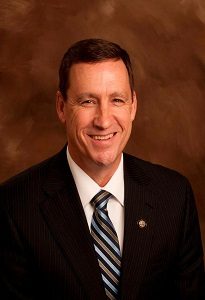
The audit, proposed by Republican state Sen. Dennis Pyle, will examine several questions such as whether county election officials have policies and procedures to ensure the accuracy and security of voting machines.
“For quite some time now, many people including some of our own constituents have been sharing their concerns and questions with their elected officials about the election and activities surrounding election processes,” Pyle told the committee Friday.
After following debates about election law changes in the Kansas Senate and reading reports from examinations of elections in other states, Pyle concluded there is an opportunity for making “our processes more transparent and accountable.”
“It’s also becoming more apparent that whether or not Kansas has issues, we should be taking further steps to ensure prevention of election fraud and abuse, to restore public faith in our elections,” he said.
“I believe this audit is one step that could bolster public confidence,” he said.
The audit of the November 2020 election seeks to examine the following:
- Do county election officials have adequate policies and procedures to ensure the security of storage units, ballots and devices used to tabulate votes?
- How do Kansas’ practices for maintaining and sharing ballot images and cast vote records compare to other states’ practices?
- Do county election officials receive adequate training to administer federal elections?
- What policies and practices do the secretary of state and county election officials have to protect the integrity of voting for long-term care facilities?
The audit comes at a time when questions are being stirred about the Kansas elections, notably by former Johnson County Commissioner Mike Brown, who is running for secretary of state in the Republican primary.
There was a renewed battle in the Kansas Legislature this year over state election laws and how far Kansas should go to make voting accessible.
There is now an effort in the Kansas Legislature to limit advanced mail ballot drop boxes out of fear they could be vulnerable to vandalism or tampering.
During the legislative session, a Senate committee held a hearing on “election integrity,” where a number of skeptics questioned Kansas elections without solid evidence of fraud.
There’s been no evidence of election fraud in Kansas, and Republican Secretary of State Scott Schwab has told lawmakers as much.
U.S. Sen. Roger Marshall has stood by the Kansas election system on national television.
And the head of the Republican Party has said there is no widespread election fraud in Kansas, although he distinguishes that from efforts to improve election security.
Democrats on the committee questioned the need for an audit of the 2020 election, the races in which were won overwhelmingly by Republicans who held onto their legislative supermajorities in the House and Senate.
“I don’t think it’s necessary,” said Democratic state Sen. Ethan Corson of Fairway.
“I don’t think it’s a good use of our professional, award-winning auditors’ staff time,” he said. ”
“This issue has been looked at repeatedly by the secretary of state’s office, by county election officials, by numerous committees in the Legislature,” he said.
“We have had nothing but every indication that we had a safe, fair and free election in November,” he said.
Corson said he didn’t think it was worthwhile to go back to review an election that’s now almost 2 years old.
Democratic state Rep. Jason Probst of Hutchinson also questioned the usefulness of a 2020 election audit that won’t be completed until after this year’s election.
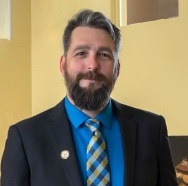
“It does seem to me if we really have a genuine interest in addressing this and looking at this, we would not look two years back on an audit that won’t be done until after November,” Probst said.
“In my view, it’s going to be a misuse of staff time and resources to put them to work on a seven-month-long audit that will have no value to the next election,” he said.
Pyle said the audit is intended to understand the processes and procedures in place for handling ballots as well as the safeguards for voting in nursing homes.
“It’s about today and it’s about tomorrow,” he said. “I am simply trying to address the concerns of the people out here on the ground that want this audit.”
Republican state Sen. Caryn Tyson, a candidate for state treasurer, said a look back at the 2020 would be worthwhile.
“I think this needs to be as soon as possible,” Tyson said. “A look back is how you discover mistakes made. You always do a post mortem. That’s where you find where the holes are.

“You don’t look to the future.”
Republican state Sen. Mike Thompson of Shawnee, who sits on the committee, has encouraged Kansans in a Facebook post to sign an online petition calling for a “forensic audit” of the 2020 election.
Thompson backed the audit, saying it was of the “utmost importance.”
“The only way that we’re going to restore faith in our election integrity is by taking this step,” he said.
“This is good first step,” he said.
“There may be more coming that we need to look at,” Thompson said, suggesting that the voting machine’s software might need to be examined as well.
Lawmakers left open that more questions could be added to the scope of the audit within the next five days.
Schwab sent a letter to the committee, cautioning lawmakers about undertaking an audit during an election year when county election officials would still be adjusting to the changes that new election boundaries bring.
“It is vital that county election officials are able to focus on implementing this year’s elections accurately and securely,” Schwab wrote in a letter to the committee.
“This year, redistricting places an additional responsibility on election officials.
“Once maps are approved, election officials will be working on a tight timeframe to
update maps, voter registration records, and candidate filings prior to the start of the primary election which begins on June 18 with the mailing of ballots to members of the military and overseas citizens.

“During this critical time, it is important to consider the impact on county election official’s resources that other activities may require.”
He also noted that there are limits to examining the voting machines.
He said a 2017 presidential executive order deemed election administration as “critical infrastructure.”
The order, he said, means that voting equipment cannot be accessed alone and is supervised by a sworn elected county election official.
When election equipment is not in use, he said, it is stored in locked facilities or cages and
sealed to ensure no unauthorized access occurs.
Third parties are prohibited from accessing and opening voting equipment, he said.
Violations of this void the warranty and security of the voting equipment and will result in voting equipment being permanently taken off-line and replaced, he said.
In a statement issued early Friday evening, a spokeswoman noted that Schwab proposed election audit enhancements in his legislative agenda.
“We look forward to working with LPA while safeguarding the critical infrastructure of our election systems,” Whitney Tempel said.
Tempel noted that Schwab is pushing a bill in the Legislature that would call for more election audits.
County election officers in presidential election years are currently required to audit one federal race, one state legislative race and one county race.
The same law requires county election officers to audit in nonpresidential election years one federal race, one statewide race, one state legislative race and one county race.
The new bill would authorize the secretary of state to randomly select four counties of varying sizes to be audited.
The audits would be conducted in odd-numbered years following a a federal general election.
“I don’t look at audits as a bad thing. I think it’s a good thing,” said Republican state Sen. Rob Olson, chair of the audit committee.
“In the best case, everything is working right,” he said. “There’s always a few recommendations that come out of them.
“I believe if we do this audit, there’s going to be a lot of good things that we’ll be able to work on in the future, hopefully together, to improve our election laws.”