





(Updated to include comments from governor and Kansas Family Voice and the screening panel voting results plus comments made to the screening panel last year about judicial philosophy)
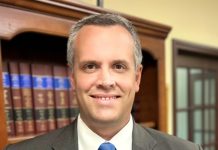
In five years, Christopher Jayaram of Lenexa has vaulted from a lawyer in private practice to seat on the Kansas Supreme Court when he was appointed Monday by Gov. Laura Kelly to the state’s highest court.
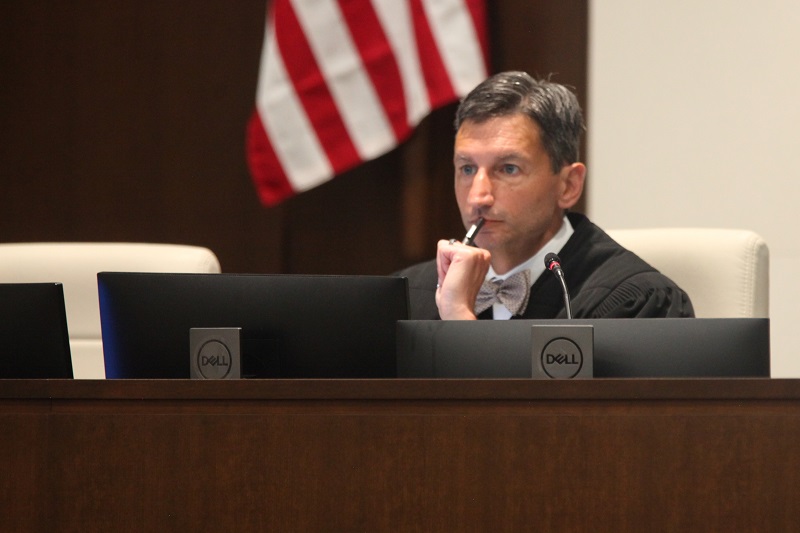
Kelly picked Jayaram over Johnson County District Judge Robert Wonnell and Douglas County District Judge Carl Folsom III, who the governor had nominated for the Kansas Court of Appeals twice but he was not confirmed by the state Senate.
Jayaram was selected from a field of seven candidates who interviewed for the position with a screening panel that is made up five lawyers elected by their peers and four nonlawyers others picked by the governor.
The screening panel recommended Jayaram, Wonnell, and Folsom. The governor picked one.
Jayaram is a 1997 graduate of the Northwestern School of Law at Lewis and Clark College in Portland, Oregon and had been an attorney at Horn Aylward & Bandy in Kansas City, Missouri when he was appointed a Johnson County district judge in 2021.
He specialized in business and commercial litigation, health care law, product liability litigation and trucking litigation when he was in private practice.
A 1993 graduate of the University of Kansas with a bachelor’s in environmental science, Jayaram worked for the Environmental Protection Agency out of school and later as a law clerk in the trial division of the Oregon Department of Justice.
He later worked for the Portland law firm of Smith, Freed, Heald & Chock before moving to Kansas City.
“Judge Jayaramn has dedicated his career to the thoughtful and impartial application of the law,” Kelly said.
“Since joining the Johnson County District Court in 2021, Judge Jayaram has presided over some of the most consequential matters that have come before our courts,” she said.
“As a family court judge, he handled complex cases involving divorce, child custody, parentage, protection from abuse and other deeply personal disputes that required not only a strong command of the law but also fairness, patience and sound judgment.” she said.
“Presently, he’s been overseeing complex civil litigation and business disputes,” she said, adding that his breadth of legal experience “provided him the opportunity to tackle difficult legal questions ” that prepared him well to be a judge.
As a district judge in Johnson County, Jayaram has presided over the legal challenge to state abortion restrictions.
Three years ago, he agreed to temporarily block the state’s 24-hour waiting period for abortions as well as a 2023 law requiring physicians to notify women that their drug-induced abortion can be reversed.
He issued a temporary injunction preventing the state from enforcing broad sections of the Women’s Right to Know law, which was first enacted in 1997 and has been amended six times since.
The case is still pending before Jayaram, who could potentially decide on a request for a permanent injunction before he is sworn in as a Supreme Court justice.
The governor’s appointment comes in the shadow of an Aug. 4 primary election when Kansas voters will decide whether to scrap the current system of selecting Kansas Supreme Court justices and elect them outright instead.
Kelly said she didn’t make her appointment based on political factors in the context of the constitutional amendment.
“I don’t think that these ought to be political positions,” Kelly said. “And I was not about to start using political considerations to decide who I would appoint to the court.”
Kelly has now appointed four of the court’s seven members although those justices might have to stand for election if voters approve the constitutional amendment next month.
She stood by the current system, saying that the moving to elections would put the court up for bids.
“There are a number of states that elect their Supreme Court justices,” she said.’
“I think all you need to do is take look at some of the recent elections and the amount of money coming through from outside those states to influence the decision,” she said.
“I don’t think we want that here in Kansas,” she said. “I think the merit-based selection process has resulted in Kansas having an extremely responsible, fair, impartial court that really does serve the best interest of Kansans,” she said.
Groups who support the amendment said the process used in this instance justified changing the process for how judges to the high court are picked.
“No matter the judge the governor chose, the people had little to no say in this decision,” said Brittany Jones, president of Kansas Family Voice.
“The selection of Judge Jayaram only highlights how out of touch our current selection process is. Over the last several years, I have watched Judge Jayaram make rulings based on political bias and not on the law.
“I have seen him ignore or rewrite some of the most basic rules of civil procedure. He does not reflect the people of Kansas or this supposedly impartial court. It is time for the people to take back the bench.”
Elizabeth Patton, regional director for Americans for Prosperity in Kansas, also criticized the appointment.
Patton is one of the directors of a new nonprofit social welfare group called the Your Right to Vote Association, which is campaigning for the amendment.
The group has already booked or spent about $468,000 on broadcast TV campaigning for the amendment.
“It’s no surprise that Gov. Kelly and the nominating commission – who regularly donate to Kansas’ most progressive candidates – chose yet another leftist judge to the Supreme Court today,” Patton said.
“This should be the final nail in the coffin of this corrupt and undemocratic process,” Patton said. “Kansans deserve better than a clique of activists masquerading as impartial experts selecting the most
This is the second time Jayaram sought a seat on the Kansas Supreme. He previously was one of three finalists submitted to the governor who chose private attorney Larkin Walsh for seat on the court.
He didn’t take questions from reporters after he was introduced by the governor.
But in an interview with the screening panel last year, Jayaram was asked about his philosophy in interpreting the constitution.
““Generally speaking, I think my philosophy in terms of interpreting documents, whether they’re statutes or whether it’s the constitution, it is important to maintain consistency,” he told the screening panel last year.
“Stare decisis means something. I think that’s important for a judge on the Supreme Court. There needs to be some pragmatic review of issues as they come up.
“Generally speaking, I think that you need to review the text from a pragmatic standpoint while still giving fidelity to the actual words that are in the constitution.
“It’s hard in a vacuum to talk about that. My philosophy just as a judge generally would be to try to be pragmatic in terms of solutions and outcomes depending on the facts and circumstances and depending on what you’re interpreting.”
He also was asked if he was ready to become more of a “political animal” if the Kansas voters approve a constitutional amendment that calls for electing justices to the Kansas Supreme Court.
“That’s a great question,” he said.
“I guess what I would say is I am not a political animal. I don’t know that I will ever be a political animal. If that were to come to pass, I think at that juncture I would be prepared to move forward with seeking retention under an elected system.
“I don’t think that is going to change who I am as a person or how I would run a campaign. It’s not something I relish.
“It’s not something I think is susceptible to bringing in the best and the brightest to be a judge. I think there are inherent risks. But if that’s what ends up happening, then I will be prepared to move forward in a way that I can best do it.”
When asked what set him apart from other judicial candidates, Jayaram cited his experience as a trial judge, calling it “critically important.”
He said his judicial experience coupled with his diverse legal background in private practice that included medical malpractice work, product liability work and class-action litigation, would make him an asset to the Supreme Court.
He said that background gives experience in dealing with many issues that could come before the court.
When the screening panel voted on the candidates in May, Jayaram led all three rounds of balloting, receiving nine votes each time.
He led the first round followed by Folsom and Wonnell each with eight votes, federal prosecutor Molly Gordon with six and District Judge Amy Hanley tied at four with Kristen Wheeler, chair of the Board of Tax Appeals.
In the second round, Jayaram led with nine votes followed by Folsom with seven, Wonnell with six and Wheeler and Gordon each tied with five. Hanley didn’t get out of the second round.
In the last round, Jayaram finished with nine votes followed by Folsom with seven and Wonnell with five. Gordon and Wheeler tied at three votes. The top three were recommended to the governor.
Overall, Jayaram amassed 27 votes over three rounds of voting compared to 22 for Folsom and 19 for Wonnell.