



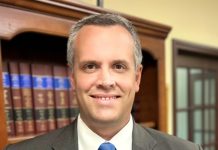
Four Republican candidates on Friday night confronted an array of major issues facing the state ranging from data centers to the Chiefs deal to property taxes to education in an hourlong debate marked by spicy exchanges between Senate President Ty Masterson and businessman Philip Sarnecki.
Masterson and Sarnecki have been trading punches on social media and in broadcast media leading up to Friday night’s statewide televised debate at Johnson County Community College and held by the state GOP.
The antipathy between the two surfaced within the first minutes of the debate that also included Secretary of State Scott Schwab and former Johnson County Commissioner Charlotte O’Hara.
And at one point during the debate, Masterson referred to Sarnecki as an “angry elf” and said he was “all hat, no cattle.”
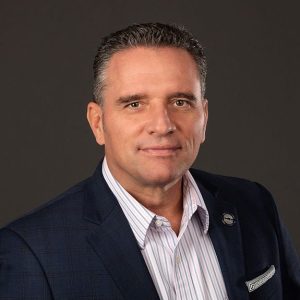
Masterson emphasized his support from President Donald Trump throughout the debate, while Sarnecki continued stressing that he would bring a fresh approach to government compared to the “career politicians” he’s running against.
Answering a question about how data centers should be regulated, Sarnecki suggested that Masterson’s support for a 20-year sales tax exemption for the facilities should be blamed for them wanting to come to Kansas.
Sarnecki has called for a five-year moratorium on data centers but would allow voters to decide whether they should locate in a community.
Sarnecki accused Masterson of stealing his plan after the senator said decisions about data centers should be made locally. Masterson said data centers should have to pay for or access their own power.
He and Sarnecki agreed that the government should not take property for data centers.
Immediately after Sarnecki’s comments, Masterson fired back.
“All he has are half-truths and lies,” Masterson said.
“I know why he’s angry,” Masterson said. “President Trump evaluated this race. It was not a real challenge. He completely and totally endorsed me and wanted nothing to do with Phil Sarnecki.”
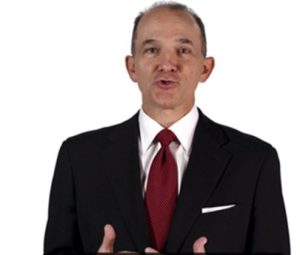
Masterson then accused Sarnecki of giving financial contributions to Democrats, including U.S. Sen. Chuck Schumer and U.S. Rep. Hakeem Jeffries.
Sarnecki invoked his mom and denied the allegation, saying he gave one $250 contribution to a Democratic insurance commissioner 15 years ago.
“My mom’s here tonight so to call me a liar, be very, very careful because she’s not going to like that, and I’m not lying,” he said.
Schwab said data centers should be regulated more by local government than state government.
“What is good for eastern Kansas or south-central may not be good for western Kansas,” he said.
“Every time you try to do a model and policy out of Topeka, it works about as good as when you do a federal model and policy coming out of D.C.,” he said. “It just doesn’t work.”
“There are some communities that want data centers and they embrace them. They’re not in the news that much,” he said.
“There are some that don’t. So that county commission and those city officials that are duly elected can be held accountable for the decisions they make,” he said.
O’Hara said data centers are being lavished with tax incentives, whether at the state or local level.
“We need to have a moratorium until we get a hold of these tax incentives,” she said. “They need to pay their fair share. It’s not going to be good for Kansas.”
Later in the debate, Sarnecki blamed Masterson for a ballooning state budget in which state spending has increased from about $15.3 billion in 2016 to $25.8 billion in 2025. The state is now spending more than it’s taking in.
“Ty loves to spend your money,” Sarnecki said.
Sarnecki was asked by debate moderator John Holt what he would cut from the budget, an answer that he appeared to struggle with.
“Mostly, there’s a lot of waste in our, uh,uh, sorry, our department, exactly,” he said when time expired.
Masterson responded, calling Sarnecki and “an angry elf” and said he wouldn’t “wallow” in the mud with Sarnecki.
“I know he’s just angry because I got the endorsement. They want nothing to do with him. He’s all hat, no cattle,” Masterson said.
Sarnecki tried to interject, “The record says you are what your record says you are.”
The four candidates split on the deal to bring the Kansas City Chiefs to Kansas from Missouri.
Masterson and Schwab agreed with the incentives package for the Chiefs. Sarnecki and O’Hara opposed the financing arrangement for Chiefs.
“It’s about the jobs, the billions of investment, the hundreds of millions in new tax revenue that are coming,” Masterson said of the Chiefs deal.
“That is again why the president endorsed me,” Masterson said. “He understands we do not need just things made in America, we need investment in America, and I want those things in Kansas.
“We were trucking money out of here to Missouri, and this is a huge opportunity,” he said. “We didn’t need to raise a single tax to bring the NFL to Kansas and bring all that excitement.”
Asked about the fact that Chiefs won’t pay property tax on the new stadium in Kansas City, Kansas, Masterson said the state will make millions in income taxes paid by the NFL as well as the property taxes that will be paid by the ancillary development around the stadium.
Sarnecki criticized the timing of the deal and said it was not one he would have made, adding that the deal included a suite at the $3 billion stadium, which is financed by bonds that will be paid for out of new tax revenues generated by the facility.
“This is what happens when you get career politicians negotiating business deals for the first time in their lives,” he said.
“Here’s one of things that Ty and (Gov.) Laura (Kelly) did together,” he said.
“They gave themselves a luxury suite paid for by all of you, the taxpayers. I just think that is tone deaf to what’s going on out there right now,” he said.
Sarnecki said the deal is now done and asked, “To make this deal try to work, do you want a businessperson doing it or do you want a career politician doing it?”
Sarnecki was pressed to defend how it was a bad deal given that 29 NFL teams have public-private partnerships and the Chiefs are projected to produce $1 billion a year in economic benefits.
“I think it remains to be seen,” he said.
“The problem is where our economy is right now, where our property taxes are right now, where our income tax is right now,” he said.
“I just think we could have done a lot better negotiating the deal and we didn’t negotiate a good deal.”
Schwab said the state is not giving the Chiefs any money up front.
“In that area, you get no sales tax because it’s grass,” Schwab said of the planned stadium site. “Nobody’s taxes are going up.”
He added that new taxes will come from the businesses that locate near the stadium. Further, he said, the property in that area will be reclassified from agriculture to commercial, which will pay a higher tax rate.
“They’re not getting much property tax revenue right now,” he said.
The candidates were asked a multiple choice question: Would they cap tax appraisals, give voters the power to block local government spending, do both or neither.
O’Hara said she would neither cap appraisals nor restrict local government spending. Her solution: Abolish the property tax and replace it with a use tax.
She pointed to a bill considered by the Legislature last session that would have phased out property taxes and replaced them with a surcharge on retail sales with some exemptions.
“Our property tax system is broken. I don’t know how to fix it,” she said.
Sarnecki blamed Masterson for not resolving the property tax issue for Kansas.
“For three straight years, Ty Masterson and the career politicians have promised property tax relief,” he said.
“They said it’s a top issue, ‘We’re going to get property relief done.’ For three straight years they’ve done that and for three straight years, how much property tax…have you received?”
“That’s right. None,” he said. “However, green energy, wind farms, Panasonic, foreign companies, they’ve all gotten property tax relief. There’s property tax relief to be found, just not for the people of the state of Kansas.”
“That is because of the lobbyists and special interests that have Ty in their back pocket,” he said.
Sarnecki said he would cap property appraisals and limit local government spending.
Masterson said the Senate upheld its commitment to limiting property taxes by passing a bill multiple times that would have capped property appraisals only to have it defeated in the House.
“We didn’t fail. We succeeded,” Masterson said. “A small group of phony Republicans sided with the Democrats and stopped it in the House.”
Masterson said he would cap property appraisal and limit local government spending.
“When you don’t cap – whether it’s the assessed value or the appraisal – you’re taxing somebody on an unrealized gain,” Masterson said.
“Property tax is something that has to be tackled. It cannot be ignored,” he said.
“You have to have a front door on the appraisals or the assessment and you also have to have the voters stop outrageous spending,” he said.
Schwab expressed concern about a static cap on property appraisals, calling it “anti free market” while saying it would hurt real estate development.
He advocates for allowing voters to approve property tax increases when they exceed a fixed threshold that would be set by the Legislature.
“Every time (local governments) say they want to raise the mill levy, let the people in that jurisdiction vote on it,” Schwab said.
“If it passes, clearly they’re OK with their property taxes going up,” he said. “If it fails, you’re going to have to rein in spending. It’s a win-win for those local units of government and the voters.”
He’s also proposed giving homeowners back some of their property taxes if their property sells for less than it’s worth.
His plan says if homeowners sell their property within 12 months of the Jan. 1 assessment date for 10% or more below the county’s appraised value, they may apply to the county for what he described as a “post-sale reconciliation credit.”
Each candidate also was asked about whether they favor consolidating smaller school districts in rural areas.
Sarnecki said Kansas has 286 school districts compared to a state like Florida with 67 districts and 20 million more people and Utah with 41 districts with about a half-million more people.
Sarnecki then moved on to discussion about declining ACT scores in Kansas and explaining why he enlisted former Wichita school board member Joy Eakins as his running mate.
Sarnecki said he plans to make her an “education czar.”
He called for “transformational” change in Kansas education.
Schwab said there are too many school districts.
He proposed setting a student population threshold for each school district by a certain year or they will have to merge with a neighboring district. And if they don’t, the state school board will undertake the merger.
“That’s not closing a school,” he said. “What you’re doing is eliminating a lot of superintendents,” he said.
“They protect their turf. They don’t want that to happen,”
He said consolidating small districts would save money in administrative costs that will be spread out over a broader base.
Masterson said the problem with education isn’t necessarily the size of school districts.
“We have lots of other problems in education,” he said.
“Our parents need freedom to choose. Our kids need access to world-class education.
“We have the ability to do that.”