






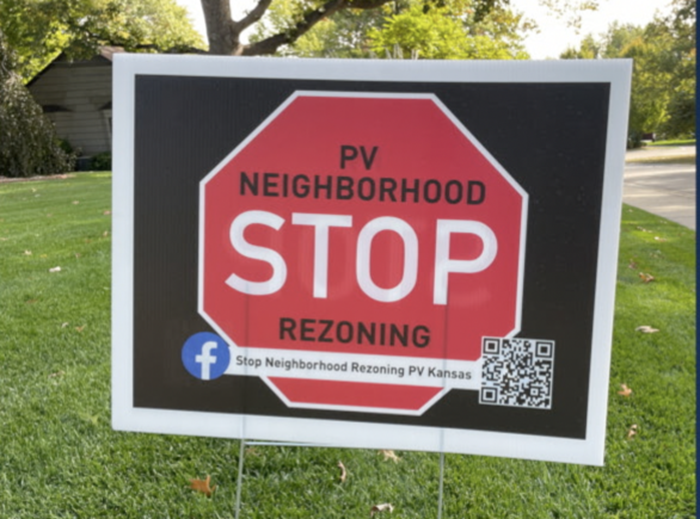
Just how much of a hand should residents have in governing Kansas cities?
It’s an issue at the center of a debate over a bill that would expand residents’ ability to force cities to enact laws through initiative petitions.
It’s bubbling up in Topeka after a judge ruled last year against a petition that would have restricted rezoning in Prairie Village.
The petition was rooted in a controversy over Prairie Village’s effort to rewrite zoning laws to allow for more duplexes, apartments and other affordable housing alternatives.
A similar situation played out in Westwood where a judge rejected a petition from residents seeking to stop the sale of the city’s only park to a real estate developer.
In Kansas, cities are the only level of government where residents can propose or initiate a local law signed by a set number of voters.
However, there’s a limit built into the law.
Voters can only petition for regulatory changes in law, or something that creates new law.
They cannot petition for administrative changes, or something that defines how a law should be carried out or administered.
The bill would eliminate the exception for administrative ordinances, which critics say is used to shield cities from initiative petitions intended to hold government accountable.
They say it leaves the decision about citizen-led petitions in the hands of judges to decide what is “regulatory” in nature and what’s “administrative.”
“The administrative angle is the thing that cities use to tie up all of this legislation to make sure it’s not voted on,” said Prairie Village lawyer Rex Sharp, who testified for the bill.
Without the bill, Sharp said initiative petitions “will be tied up in needless, expensive and lengthy litigation.”
The bill was “blessed” by Republican leadership in the Senate to advance past the Feb. 23 turnaround deadline.
Republican state Sen. Mike Thompson of Shawnee said he plans to work the bill. He expects to amend the legislation so it’s narrower in scope.
Cities say the bill – as now written – could potentially open the door for initiative petitions that could control the day-to-day functions of government, ranging from how trash is collected to the material used to resurface streets.
“Allowing the use of this process for administrative ordinances is a dangerous game,” said Topeka City Attorney Amanda Stanley.
“The state is gambling on the possibility a city will be frozen in time for up to a decade on a crucial action,” Stanley said in written testimony.
“It prohibits flexibility and subverts the role of the elected local officials we elect to run our cities and vet public policy with a full understanding of the facts.”
Stanley noted that there have been many attempts over the years to enact administrative ordinances through petition initiatives.
Those efforts included prohibiting prime city land for being used for anything but a cemetery, dictating the location of a fire station, abolishing a city office, and setting the terms for the sale of real estate.
In each of those cases, the attorney general issued an opinion that found those proposed ordinances to be administrative in nature and could not be enacted through the initiative petition process.
“Administrative ordinances could be used to defund police departments and eliminate city
services that are need to accomplish the stated goal of the ordinance,” Stanley said.
The “ordinances are often drafted by individuals with strong feelings on a topic that might not represent the public as a whole.
“However, these petitions are rarely signed by citizens who have a complete understanding of the effect of the ordinance and a city is very limited in how it can educate the public on why a yes vote is a bad idea.”
Earl McIntosh of Topeka urged lawmakers to support the bill, saying that it’s hard to overcome a ruling that a petition is administrative and not regulatory.
“I believe that any ordinance right now submitted by any town in Kansas would be determined administrative or they’d have some other reason to invalidate the petition,” McIntosh told legislators.

Spencer Duncan, lobbyist for the League of Kansas Municipalities, said the courts have clearly distinguished the difference between an “administrative” and “regulatory” ordinance.
The Kansas Supreme Court has set out guidelines for what’s considered administrative and what’s defined as regulatory.
For instance, the court determined an ordinance that makes new law is legislative, while an ordinance that executes an existing law is administrative.
Duncan said the concerns raised with the bill stem more with frustration with zoning issues than the definition of what is defined as an “administrative” ordinance.
“Where this frustration has come from for this bill in particular largely is due to zoning issues, frustration with cities and how they’ve handled certain zoning or opposition to zoning issues,” Duncan said.
“There’s some legitimate concerns in there,” he said. “Then let’s address the zoning concerns or keep this kind of bill specific to zoning issues.”
Under the law, a proposed ordinance may be submitted to the city by a petition signed by at least 25% of the voters in a first-class city and at least 40% of the voters in a second- or third-class city.
The city council must either adopt the ordinance without amendment within 20 days of receiving a valid petition or hold an election on the proposed ordinance.
If a majority vote in favor of the proposed ordinance, then it becomes valid and binding and cannot be repealed or amended except by a public vote.
Mike Sullinger of Prairie Village implored the Senate Federal and State Affairs Committee to pass the legislation.
“You are our last our hope in making sure democracy continues in our city and our residents have a say in how our city’s future is shaped.”