


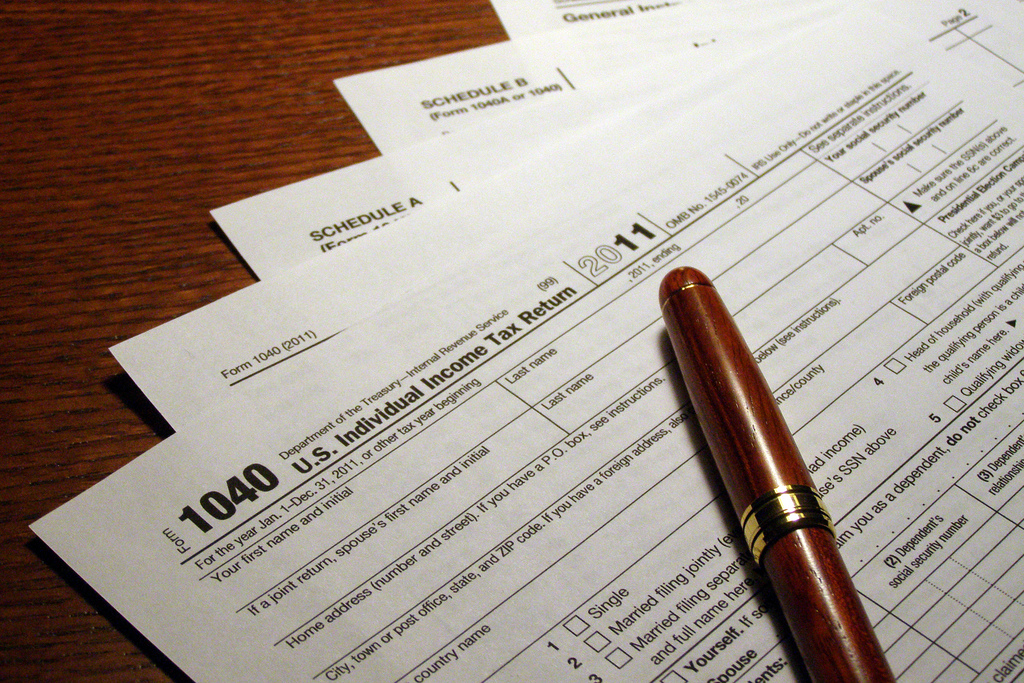
The Kansas Chamber of Commerce has introduced a proposed flat tax that would collapse the state’s three tax brackets for individuals into one and use excess revenues to lower income tax rates.
The chamber’s bill calls for a 5% income tax rate for individuals while exempting $15,000 in income for individuals and $30,000 for married couples.
The bill would set a rate of 5% for corporations, which now pay 4% on net income plus 3% on net income exceeding $50,000.
It also lowers the tax for banks and savings and loans, a move intended to reflect the same percentage increase in the corporate tax code.
The bill lowers the rate for banks to 3.13% from 4.375% and the rate for savings and loans to 3.21% from 4.5%.
The bill also would buy down income tax rates using revenues in excess of estimates.
The bill calls for reducing the income tax rate to zero, which led some critics to sound alarms about how such a plan might affect the state’s fiscal outlook.
The chamber sees the bill as an initial offering for debate this session and not the finished product ready to go to the governor.
“We’re open to ideas,” said Eric Stafford, the chamber’s vice president of government affairs.
“This is our starting point of what we believe would be a good start to help truly grow the state,” Stafford said.
The chamber’s bill sets up the framework of what is expected to be a lively debate over taxes with the state sitting on a surplus of $2.3 billion for this fiscal year and a projected surplus of $3.2 billion for fiscal year 2024.
A fiscal note for the chamber’s bill hasn’t been prepared, but an analysis of a 4.75% flat tax proposed only for individuals last year was estimated to have cost about $500 million over three years.
Supporters of the flat tax say it’s simple, fair and promotes growth. Opponents say it hurts low-income earners while benefiting more wealthy taxpayers.
“Graduated-rate tax systems penalize productivity and hinder upward mobility, while flat tax structures are more conducive to long-term economic growth,” said Katherine Loughead, senior policy analyst with the conservative-leaning Tax Foundation.
Stafford disagrees that the flat tax would disproportionately hurt the less advantaged by forcing them into a higher tax bracket.
He notes that the chamber’s proposal exempts income under $15,000 for single filers and $30,000 for married couple from income taxes.
Under the current system, those low-income earners – of which there are more than 400,000 single filers earning under $15,000 in Kansas – now pay 3.1% in income taxes.
Stafford said income under $15,000 for single filers and under $30,000 for married filers was exempted to address concerns about hurting the less affluent.
“Critics often argue that going to a single rate will have a negative impact on low-income taxpayers, which is why we included the exemption to take away that argument,” Stafford said.
The flat tax would be a significant departure from Democratic Gov. Laura Kelly’s proposal to accelerate elimination of the state sales tax on food, create a sales tax holiday for school supplies and cut taxes on Social Security income.
Kelly has urged the Legislature to adopt a tax plan that was “responsible,” not something that would throw the budget into disarray.
Kelly in a recent interview expressed reservations about a flat tax and what it might mean for low-income earners in Kansas.
“I don’t know that the flat tax is so much irresponsible as incredibly regressive and unfair,” Kelly said in an interview with the Sunflower State Journal.
“I’ve always seen the flat tax as regressive,” she said. “I am not enthusiastic about it.”
Senate President Ty Masterson said he supports a flat tax, but in a recent interview said he would like to work with the governor on a tax package.
He would like to see a package that addresses the food sales tax, eliminates the tax cliff on Social Security income and flattens income tax rates.
“I’m optimistic we can even get to signature,” Masterson.
Kansas Action for Children said the bill wouldn’t help most Kansans.
“Let’s be clear,” said Emily Fetsch, director of fiscal policy for Kansas Action for Children.
“Kansas experimented with similar risky tax plans a decade ago, and we all saw how everyday Kansans suffered as a result,” Fetsch said.
“We cannot go back to unjust tax cuts that favor the rich and take from those living on low- and middle-income wages.”
The Senate’s top Democrat promised to closely examine any tax proposal coming from the majority party.
“Our caucus is always willing to work with the majority party on their proposals, but we’ll scrutinize any policies that would disproportionately harm low- and middle-earners.” Sen. Dinah Sykes said in statement.
“We have a duty to our constituents to be fiscally responsible, and tax relief should be targeted to Kansans who need it most,” she said.