






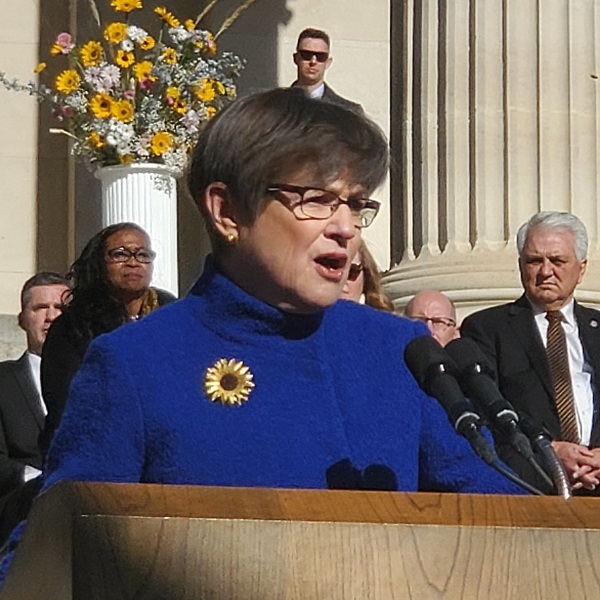
Gov. Laura Kelly on Monday called for the state to move to a more centralized and coordinated system of providing early childhood services in an effort to make them more accessible and affordable.
The governor pointed to findings in the new early childhood development report that concluded the existing system for childhood services is “inadequate and overly complex,” noting that they are splintered between four different state agencies.
“These agencies all do great work, but they’re doing it in silos and the lack of coordination among these programs leads to redundancies, inefficiencies and barriers for families seeking services,” Kelly told the task force before it approved its report.
“We need to streamline and consolidate this work in a way that will make it easier for our families to access services, enable businesses and individuals who provide them to thrive, and make the bureaucratic systems that facilitate them more efficient, more effective, and more accountable,” she said.
The task force, created by an executive order signed by the governor, noted that states are increasingly developing new oversight structures that consolidate authority over programs and services with one office.
The task force was charged with leading the review and creating a framework for what the unified system of services might look like.
“Current systems of early learning governance are typically dispersed through multiple agencies and departments, often causing sub-optimal messaging, effectiveness, and access by families,” the task force report said.
“State leaders and policymakers can help align agency mandates and goals…to increase and streamline quality, access, and delivery of early childhood services,” the report said.
The report said states are either creating new agencies with authority over early childhood services, consolidating those services or placing authority and accountability for them in a coordinated approach across multiple public agencies.
“Within each approach to governance, there is the opportunity for greater or lesser decentralization, empowering local communities or regions to initiate, implement, and monitor efforts,” the report said.
“There is also the opportunity for states to support public-private partnerships, a mixed-delivery system, and flexibility to utilize partners to support oversight.
“Most importantly, the variety of governance structures provides the opportunity for each state to identify the approach best suited for their state’s needs, children, and families.”
The report gave these examples of what states doing:
- The Connecticut Office of Early Childhood was created to improve the delivery of early childhood service. The state has a cabinet-level agency, incorporating early childhood programs previously overseen by the Departments of Education, Social Services, Board of Regents, Developmental Services and Public Health.
- Two years ago, Republican Missouri Gov. Mike Parson announced the consolidation of the state’s key early childhood programs into a single Office of Childhood. This consolidation brought together early learning, after-school, home-visiting and child care programs into one office, housed in the state’s Department of Elementary and Secondary Education.
- Delaware is in the process of consolidating a number of programs – including child care and early intervention services – into the Office of Early Learning at the Department of Education. Created in 2020, this new structure is intended to improve efficiency and promote the alignment of eligibility, monitoring and quality improvements.
The task force report recommended that the state streamline its early childhood governance structure by unifying early childhood care and education services into a single state entity.
The task force recommended that a number of services should be located under the umbrella of one agency, including child care programs, the Kansas Children’s Cabinet and Trust Fund, home-visiting programs and the Head Start Collaboration Office.
The task force did not recommend moving preschool programs currently within the Kansas State Department of Education, health programs and child welfare programs.
The report recommended that a single agency should be located within the executive branch, operate under the jurisdiction of the governor and “be led by a highly-qualified, permanent administrator.”
The administrator should report to the governor and serve at their pleasure, the report recommended.
The administrator should either be considered a permanent member of the governor’s Cabinet or be elevated to a cabinet-level position.
The report recommended that process for reforming start next year with a goal of completing realignment by 2026.
The task force included representatives from business, government, advocacy and early childhood sectors, as well as members of the Kansas Legislature.
Kelly will take the task force’s recommendations under advisement and determine the next step for beginning the process of unifying Kansas’ early childhood services.